Most tasting notes describe what a coffee reminds the roaster of, not something added to it. Place, plant, processing, and roast all shape the cup. Coffees recorded as using added ingredients are marked, and you can filter those out. Missing processing details remain unknown.
Notes are hints, not promises. Water, grinder, recipe, and your own taste buds all get a vote.
Find your flavor
Four flavor families, one for each answer on the quiz. These are tendencies, not rules. They overlap, too: a coffee can be peachy, floral and a little unexpected.
Where it shows up. Often washed or honey coffees from cool, high farms. Ethiopia, Kenya, and Colombia show up a lot, and so do perfumed plants like Gesha.
Choose a word to explore.
A coffee to try it on
DAK
Poppy Soda
Roaster’s notes: “Lemonade, jasmine tea and ripe peach”
Its recorded “Lemonade”, “jasmine tea” and “ripe peach” notes fit this family.
Where it shows up. Often classic plants like Bourbon and Caturra. Brazil and Central America are home turf, and a honey or natural process can add sweetness.
Choose a word to explore.
A coffee to try it on
Morgon
Montero Family - Costa Rica, Tarrazu
Roaster’s notes: “ripe plum, chocolate biscuit”
Its recorded “chocolate biscuit” note fits this family.
Where it shows up. Often the process talking: anaerobic fermentation, carbonic maceration, or a co-ferment. Results vary a lot, so expect a plot twist.
Its recorded “Mango & Tropical Juice” note fits this family.
Listed in stock · Checked Oct 19, 2026.
Each Find link changes the flavor only. Curiosity, budget, and any filters you already picked stay as they are. The flavor buttons inside each card explain words. They are not filters.
Examples saved Oct 20, 2026. Each coffee has its own stock check date.
Help me tell these flavors apart
Read a bag in ten seconds
Most bags answer four questions. Here is a real listing from SEY, decoded.
SEY
2026 Chorso Bule
1OriginEthiopia, Gedeb, 2,450+ m
Where it grew. Gedeb is in southern Ethiopia, and 2,450 meters is very high for coffee. Cooler farms, often high on mountains, ripen coffee more slowly, and cooler growing is linked to brighter, fruitier cups. Height is only a rough guide, because distance from the equator, shade, and processing change what it does.
2VarietyEthiopian Landrace
Which plant. Many bags say Heirloom for the same idea: a mix of local Ethiopian coffee types, not one named variety.
3ProcessWashed
What happened after picking. Washed means the fruit came off before the seed dried. SEY lists the steps: held in the cherry for 24 hours, dry-fermented for 24 hours, wet-fermented for 12 more, then dried on raised beds. Washed coffees ferment too. The word only tells you the fruit was gone before drying.
4Notesripe peach, melon, honeysuckle
What the roaster tasted. SEY's own comparison, in its words. No added ingredients are recorded for this coffee.
Sip Parade's read: its peach and honeysuckle notes and washed process match Sunshine & stone fruit. That is a match from the roaster's listing, not a tasting review.
SEY now lists this coffee as no longer available, so it is here as an example only.
The coffee decoder
This bag-and-lens stamp means “explain this coffee.” Choose Decode this coffee on any coffee card to open the guide. It starts with what the roaster tasted, then the process, place, and plant.
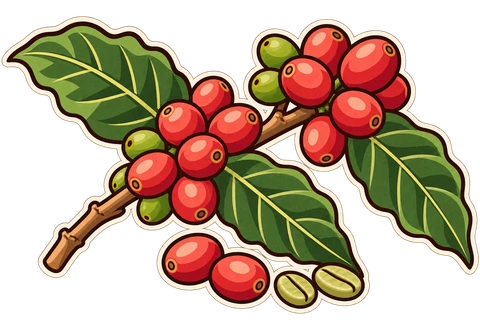
Coffee is a fruit. Each bean is the seed of a cherry that grows on a shrub. Processing is how the layers around that seed come off, and when.
There’s a bean in there.
From the outside in. Match the number and color, and choose a layer for a closer look.
A coffee bean is a seed inside a fruit called a coffee cherry.
Simplified illustration, not to scale. Colors identify the layers, not how they look in nature. Most coffee cherries contain two seeds.
How it dries
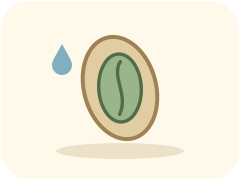
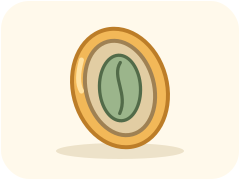
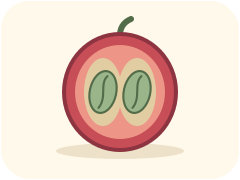
The difference is what is still around the seed while it dries.
Washed
Dries with: just the parchment.
Skin and fruit come off right after picking. The sticky layer is fermented and washed away, or scrubbed off by machine, then the seed dries in its parchment.
Possible notes: clean and crisp, often bright fruit.
Honey
Dries with: some or all of the sticky layer.
Skin and fruit come off, but some sticky layer stays on while the seed dries. No bees involved.
Possible notes: sweet and rounded, sometimes caramel or jammy fruit.
Natural
Dries with: the whole fruit.
The whole cherry dries around the seed, often for weeks, then the dried fruit comes off.
Possible notes: ripe or jammy fruit, more body, sometimes a winey edge.
Extra steps that can be added
Not a fourth way to dry. These are choices made along the way, and they combine with the three above. An anaerobic coffee is still finished as washed, honey, or natural.
Anaerobic fermentation
An extra fermentation step in a sealed tank that keeps oxygen out. Carbonic maceration is one version, with whole cherries sealed in carbon dioxide.
Possible notes: unusual fruit, candy-like sweetness, or a boozy edge. Results vary a lot.
Co-fermentation
Fruit, spices, hops, or other ingredients are added during fermentation, so part of the flavor comes from them. Many roasters say so, but labeling is not required. Sip Parade marks coffees recorded as co-ferments and lets you leave them out. When processing details are missing, an unmarked coffee is not proof that nothing was added.
Possible notes: often echo what was added.
No process is better than another, and none guarantees a flavor.
Place, plant, roast, and brew
Four little paper notes to help you read a coffee. Open only what catches your curiosity.
The setting
Place
Where the story begins
Country, region, farm, and altitude. Cooler farms, often high up, ripen coffee more slowly, which is linked to brighter, fruitier cups.
A little more about place
People call this terroir, said "tair-WAHR." It is a fancy word for place: altitude, weather, soil, and shade. Think about apples. A tree on a cool hillside grows a different apple than one in a hot valley.
Height is only a rough guide. A farm far from the equator can be cool at a lower altitude, and shade and processing change the result too.
The starting point
Plant
Meet the family
The type of coffee plant. A Honeycrisp is not a Granny Smith, and some coffee plants are known for florals, others for juicy fruit or chocolate.
A little more about plants
Gesha is known for floral notes like jasmine, and sometimes peach or tea-like notes. Kenyan coffees, often SL28 and SL34, can taste like blackcurrant.
On Ethiopian bags, Heirloom or Ethiopian Landrace usually means a mix of local coffee types, not one named variety.
Despite its name, genetic tests suggest Pink Bourbon is an Ethiopian landrace, not a type of Bourbon. The name comes from its pink cherries.
The transformation
Roast
A little heat changes a lot
Roasting builds most of the aroma. Lighter roasts often keep more fruit and flowers, which is why Sip Parade leans light.
A little more about roast
Darker roasts lean roasty and bittersweet. Great too, just a different parade.
Roast names are not standardized between roasters, so a label alone cannot tell you exactly how a coffee will taste.
Your part of the story
Brew
Make the cup your own
The farm decides what flavors are possible. Your kitchen decides how many you meet.
A little more about brewing
Starting points, not fixes:
Sour? Try grinding a little finer.
Bitter or harsh? Try a little coarser.
Weak? Try a bit more coffee.
Let it cool a bit. Sweetness and fruit are often easier to notice as the cup goes from hot to warm.
Quick questions
Is this the same as flavored coffee?
No. Flavored coffee usually has flavor oils added after roasting. Tasting notes come from the coffee itself. Co-fermented and infused coffees are the exception, since something was added during processing.
Why can't I taste the notes on the bag?
Notes are hints, not promises. Water, grind, recipe, freshness, and your own taste all change what you notice. If you catch one note, that is a win. If you taste something else entirely, that counts too.
Do I need a fancy palate?
Nope. Start with big buckets: fruity, chocolatey, or floral. The details show up one sip at a time.
Is one process better than the others?
No winner here. Washed is often crisp, natural is often jammy, and anaerobic is often a surprise. Pick the mood you are in.
Why do two bags of the same variety taste different?
Because the place, the processing, or the roast changed. Same plant, different story, different cup.
Ready to find your flavor?
Three questions, thirty coffees, and the reasons behind every pick.







 Not a fourth way to dry. These are choices made along the way, and they combine with the three above. An anaerobic coffee is still finished as washed, honey, or natural.